1

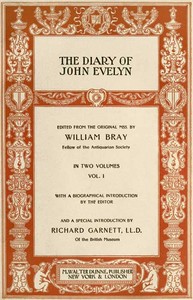
The Diary of John Evelyn (Volume 1 of 2) — Text and Context
33
2
Project Gutenberg
2012
Great Britain -- History -- Stuarts, 1603-1714; Great Britain -- Court and courtiers -- Early works to 1800; Evelyn, John, 1620-1706 -- Diaries; Great Britain -- Social life and customs -- Early works to 1800
Readers of public-domain and historical texts
Project Gutenberg digital edition
en
Edition facts
Words: 159,583
Reading time: 694 min
Text sections: 20
Source:
Project Gutenberg record #41218
John Evelyn's diary offers a firsthand account of 17th-century English life, from court and travel to architecture and natural history, edited by William Bray with a biographical introduction by Richard Garnett.
Editorial Edition Score
4.9/5
★★★★★
★★★★★
Calculated from edition completeness, EPUB availability, text structure and catalogue metadata. Not a user rating.
Edition quality
John Evelyn's diary, as presented in this first volume of William Bray's edition, opens a window onto the life of a well-connected English gentleman of the 17th century. The excerpts reveal a meticulous observer of architecture, art, and courtly affairs, with a particular eye for the material splendor of Italian palaces and gardens. Evelyn's descriptions of Florence and Bologna are dense with specific details: the number of shelves in a library, the weight of a cannonball, the precise materials of a chapel's inlay. This is not a diary of introspection but of external record, a catalog of the visible world as encountered by a man of taste and curiosity.
A Museum of the Visible World
The diary's strength lies in its concrete, almost inventory-like descriptions. When Evelyn visits the Grand Duke's villa at Pratolino, he notes the 'four pavilions,' the 'balustred with stone' platform, and the 'huge rock, with water running in a small channel, like a cascade.' He counts 'eighty-eight shelves' in a library and records that the Arsenal could arm '70,000 men.' This precision extends to art: he names the masters of pietra-commessa—Dominico Benetti and Mazotti—and buys four small figures from the statuary Vincentio Brochi, admiring his 'rare art of bronzing them.' Such details ground the diary in a world of tangible objects, making it a valuable source for material culture.
The Diarist as a Man of His Class
Richard Garnett's introduction positions Evelyn as a representative of the 'well-bred and well-conducted section of the untitled aristocracy.' The excerpts support this: Evelyn moves easily among dukes and princes, yet his tone remains that of a respectful observer, not a participant in high politics. He notes the Duke's tribute from prostitutes and the Pope's similar tax, but without moral commentary—a factual record. His diary, as Garnett suggests, is less a picture of 'stirring life' than a self-portrait of a man who values order, decorum, and the accumulation of knowledge. This is evident in his careful enumeration of precious stones—'cornelians, lazuli, serpentine, agates, onyxes'—and his appreciation for hydraulic organs and water tricks.
Travel as a Collection of Wonders
Evelyn's Italian journey reads like a sequence of marvels, each described with a blend of wonder and exactitude. At Pratolino, he is delighted by an 'arch of water' that lets a man ride under it 'without receiving one drop of wet,' calling it 'one of the most surprising magnificences I had ever seen.' He also records a grotto with 'Vulcan and his family,' walls of 'corals, shells, copper, and marble figures,' and moving beasts powered by water. These passages reveal a sensibility that finds pleasure in mechanical ingenuity and naturalistic artifice. The diary thus serves as a record of the Grand Tour's aesthetic and intellectual pursuits, filtered through Evelyn's particular, systematic gaze.
Readers approaching this volume should expect a diary that prioritizes observation over narrative. Evelyn does not offer dramatic tension or personal revelation; instead, he provides a steady accumulation of facts about the world he moved through. To appreciate the diary, one must read it as a series of discrete entries, each a snapshot of a place, a building, or a ceremony. The index and Bray's editorial notes will help navigate the dense web of names and locations. This is a work for those who value the texture of historical life over the arc of a story.
Reader reflection
Record your reading impressions
A brief reflection can help important ideas stay with you longer.
Your progress
0
/
10
2
Did this book hold your interest?
3
How likely are you to recommend this book?
4
Did the language feel accessible?
5
What did you appreciate most?
6
Did the book deliver what you hoped for?
7
How distinctive were its ideas or approach?
8
Could you see yourself revisiting this book?
9
What is the main idea you are taking away?
10