1

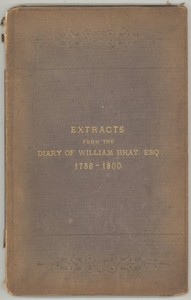
Extracts from the Diary of William Bray — Context and Discussion
2894
3
Project Gutenberg
2000
Great Britain -- Court and courtiers; Great Britain -- History -- Stuarts, 1603-1714; Bray, William, 1736-1832 -- Biography
Readers of public-domain and historical texts
Project Gutenberg digital edition
en
Edition facts
Words: 15,407
Reading time: 67 min
Text sections: 3
Source:
Project Gutenberg record #2140
William Bray's diary entries from 1756–1800 record daily social rounds, card games, and travel expenses, offering a granular view of an 18th-century attorney and antiquary's life, far from the Stuart court subjects cataloged.
Editorial Edition Score
4.5/5
★★★★★
★★★★★
Calculated from edition completeness, EPUB availability, text structure and catalogue metadata. Not a user rating.
Edition quality
William Bray's diary entries, spanning 1756 to 1800, are dominated by a single recurring pattern: dining, drinking tea, and playing whist. A typical entry reads, 'Dined at Mr. Godschall’s; Mr. and Mrs. Polhill and Mr. Wollaston there; whist till 10; won 8 s.' The catalog subjects list 'Great Britain -- Court and courtiers' and 'Stuarts, 1603-1714,' but the excerpts contain no mention of court life or Stuart-era events. Instead, the diary focuses on Bray's local social network in Surrey and London, his legal work, and his antiquarian pursuits.
A Life Measured in Shillings and Whist Games
The diary entries consistently record sums of money won or lost at cards, often with precise shillings and pence. For example, on December 28, 1786, Bray notes 'whist, won 9 s.' Similar entries appear throughout: 'whist, Sir Joseph Mawbey, Pardon, Lawson, and others, till 10, won 10 s. 6 d.' and 'whist, won 3 s. 6 d.' These financial details are not balanced by any reflection on the games themselves; they serve as a ledger of social profit. The diary also itemizes expenses like 'paid for dinner, 4 s. 6 d.' and 'bait of horses, 1 s.' This suggests Bray treated his diary as a record of expenditures and gains, not as a space for introspection.
The Social Geography of an Attorney-Antiquary
Bray's entries trace a dense network of acquaintances, many of whom appear repeatedly: the Malthus family, the Duncumbs, the Godschalls, and Sir Frederick Evelyn. He dines at private homes, clubs in Dorking, and coffee houses in London. On May 14, 1789, he records 'supped at Lincoln’s Inn Coffee House (with his antiquary friends).' This is one of the few hints of his antiquarian work, which the memoir mentions—he was a treasurer of the Society of Antiquaries and edited the 'Evelyn Memoirs.' Yet the diary itself rarely discusses his scholarly activities, focusing instead on social calls and travel between Surrey and London.
Silence on the Stuart Court
Despite the catalog subject 'Great Britain -- Court and courtiers' and 'Stuarts, 1603-1714,' the diary excerpts contain no reference to the Stuart monarchy, court ceremonies, or political events of that era. Bray's world is that of an 18th-century gentleman: he attends quarter sessions, visits the Duke of Norfolk, and goes to Vauxhall with 'Miss Adees, Mary and Caroline.' The only hint of national history is a brief mention of 'the House of Commons' on February 10, 1789. The diary's focus is resolutely personal and local, making the catalog subjects misleading for these extracts.
Readers should approach these extracts as a social and financial log rather than a narrative diary. The entries are terse and repetitive, but they cumulatively reveal the rhythms of a busy attorney's life in late 18th-century England. The memoir prefacing the diary provides essential context for Bray's career and family, which the diary itself largely omits.
Reader reflection
What was your reading experience?
Capture what you thought, learned, and would like to remember.
Your progress
0
/
10
2
Did this book hold your interest?
3
Would you encourage someone else to read it?
4
How demanding did the text feel?
5
How personally connected did you feel to the book?
6
How clearly were the main ideas presented?
7
Which element worked best for you?
8
How useful were the ideas in this book?
9
What did this book teach you most?
10