1

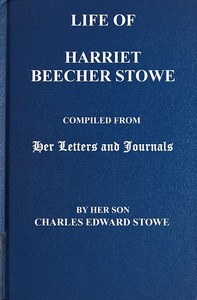
Life of Harriet Beecher Stowe Compiled From Her Letters and Journals by Her Son Charles Edward Stowe — Reading Notes
916
3
Project Gutenberg
2004
Authors, American -- 19th century -- Biography; Stowe, Harriet Beecher, 1811-1896; Women abolitionists -- United States -- Biography
Readers of public-domain and historical texts
Project Gutenberg digital edition
en
Edition facts
Words: 156,394
Reading time: 680 min
Text sections: 21
Source:
Project Gutenberg record #6702
A son's compilation of Harriet Beecher Stowe's letters and journals, revealing her authorial voice through travel observations, publishing anxieties, and domestic details, with a preface asserting the biography's accuracy as told 'in my own words.'
Editorial Edition Score
4.9/5
★★★★★
★★★★★
Calculated from edition completeness, EPUB availability, text structure and catalogue metadata. Not a user rating.
Edition quality
The preface to this volume, signed by Harriet Beecher Stowe herself, immediately establishes a distinctive authorial stance: she frames the work as a deliberate act of self-representation, noting that failing strength prevented her from writing an autobiography but that her son's compilation, drawn from letters and journals, 'has therefore all the force of an autobiography.' This framing shapes the reader's encounter with the text, presenting the letters not as raw documents but as curated evidence of a life. Stowe's voice emerges through the editorial structure, from childhood recollections to the brisk, observant travel letters of her later years.
A Voice in Transit: The Travel Letters
Elsewhere in the same letter, she shifts from social observation to publishing news with characteristic directness: 'The last I heard from Low, he had sold sixty thousand of "Dred," and it was still selling well.' The juxtaposition of ducal carriages and sales figures is typical of Stowe's epistolary style—she moves between spheres without apology. Her commentary on the critical reception of Dred is notably wry: 'The critics scold, and whiffle, and dispute about it, but on the whole it is a success, so the "Times" says, with much coughing, hemming, and standing first on one foot and then on the other.' The physical comedy of the critics' hesitation—coughing, hemming, shifting weight—turns professional judgment into a performance of indecision. Stowe's own confidence is understated but palpable; she reports sales figures and dismisses ambivalence with a metaphor of bodily awkwardness.
Domestic Interiors and the Texture of Daily Life
The same letter includes a striking passage on the reception of Dred: 'One hundred thousand copies of "Dred" sold in four weeks! After that who cares what critics say?' The exclamation marks and rhetorical question convey a burst of vindication. Yet Stowe immediately catalogues the attacks: 'The "Record" is down upon it with a cartload of solemnity; the "Athenæum" with waspish spite; the "Edinburgh" goes out of its way to say that the author knows nothing of the society she describes.' The metaphors—a cartload, waspish spite—turn criticism into tangible, almost absurd objects. Stowe's response is not defensive but analytical; she itemizes the opposition as though taking inventory, then counters with sales: 'Mr. Low says that he puts the hundred and twenty-fifth thousand to press confidently.' The rhythm of attack and counter-attack structures the paragraph, revealing a writer who tracks her own reception with a mixture of amusement and steel.
The Compiler's Hand: Charles Edward Stowe's Editorial Choices
The table of contents reveals the biography's structure: chapters progress chronologically from 'Childhood' through 'School Days in Hartford' to later travels and literary success. Each chapter heading is a simple label—'Childhood 1811-1824,' 'School Days in Hartford, 1824-1832'—suggesting a documentary rather than interpretive approach. Yet the inclusion of letters within this framework means that Stowe's own voice periodically interrupts the chronological narrative. The reader encounters not a seamless story but a mosaic of documents, each with its own date and occasion. Charles Edward Stowe's role as editor is thus crucial: he decides which letters to include, how to excerpt them, and where to place them. His choices shape the portrait of his mother as much as her words do.
Diction and the Performance of Confidence
Stowe's handling of her own literary success is particularly revealing of her authorial persona. She reports sales figures with precision—'sixty thousand,' 'one hundred thousand,' 'the hundred and twenty-fifth thousand'—but frames them as evidence of popular validation against critical scorn. The phrase 'After that who cares what critics say?' is defiant, yet the very act of listing the critics' names and their attacks suggests she cares enough to catalogue them. This tension between indifference and attention is a recurring feature of her epistolary voice. She performs confidence while remaining alert to the judgments of others, a duality that may reflect the pressures of being a woman writer in the mid-nineteenth century.
Readers approaching this compilation should attend to the interplay between Harriet Beecher Stowe's own words and her son's editorial framework. The letters offer immediate access to her voice—wry, observant, and commercially astute—while the biographical structure imposes a narrative of progress from childhood to fame. Noticing where the letters break from that narrative, or where Stowe's tone shifts between public and private registers, reveals the craft behind the persona. The volume rewards those who read it as a collaboration between two authors, each shaping the story of a life.
Reader reflection
Record your reading impressions
A brief reflection can help important ideas stay with you longer.
Your progress
0
/
10
2
Was reading this book enjoyable?
3
Would you pass this book on to a friend?
4
How demanding did the text feel?
5
Was the book what you thought it would be?
6
Could you see yourself revisiting this book?
7
How closely did the book connect with your experience?
8
Was the book moving at the right speed?
9
What changed or sharpened your thinking?
10