1

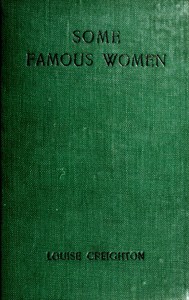
Some Famous Women — Edition Insights
798
4
Project Gutenberg
2015
Women -- Biography -- Juvenile literature; Christian women -- Biography -- Juvenile literature
Readers of public-domain and historical texts
Project Gutenberg digital edition
en
Edition facts
Words: 50,593
Reading time: 220 min
Text sections: 17
Source:
Project Gutenberg record #49766
Louise Creighton's 1909 collection profiles twelve women from St. Hilda to Queen Victoria, blending domestic detail with public achievement. The Mary Somerville chapter shows how she hid her scientific work under muslin when visitors came, a concrete example of the book's focus on the strategies famous women used to pursue their callings.
Editorial Edition Score
4.8/5
★★★★★
★★★★★
Calculated from edition completeness, EPUB availability, text structure and catalogue metadata. Not a user rating.
Edition quality
Louise Creighton's Some Famous Women (1909) opens with St. Hilda and closes with Queen Victoria, covering twelve figures across fourteen centuries. The book is pitched at juvenile readers but avoids condescension: Creighton treats her subjects as individuals navigating specific constraints. In the Mary Somerville chapter, for instance, she reports that Somerville covered her books with muslin when visitors arrived, because 'people did not think that a woman was like a man and could have any real work to do.' That single detail—the muslin—encapsulates the book's method: showing how public achievement was often built on private accommodation.
The Muslin and the Manuscript
The Somerville excerpt is the longest in the supplied material and reveals Creighton's interest in the mechanics of women's work. Somerville wrote her first scientific book in the drawing-room, hiding papers under muslin when the bell rang. She taught her children in the same room and 'answered them quickly and quietly' before returning to her own problems. Creighton notes that Somerville could 'abstract her mind' even from piano practice. The passage is striking for its ordinariness: no dramatic breakthrough, just a woman managing interruptions. Creighton uses this to illustrate a broader pattern—the need for famous women to carve out mental space within domestic obligations.
Praise and Its Limits
When Somerville's book succeeded, Creighton records the reactions in a telling sequence: Sir John Herschel's letter, the bust in the Royal Society, the king's pension of £200 a year, and the astonishment of relations 'who had found fault with her ways.' The order matters—Creighton places Herschel's private encouragement before public honours, and the relations' praise last. She also notes that Somerville 'most of all valued the deep delight of her husband.' This hierarchy of validation—expert approval, institutional recognition, family pride—recurs across the excerpts. Creighton does not moralize, but the pattern suggests her own view of what sustained these women.
Italy, Old Age, and a Mountain Sparrow
After her husband's death in 1860, Somerville continued working in Italy, writing new editions and a book on physical geography. Creighton includes a curious detail: a mountain sparrow sat on Somerville's arm for eight years while she wrote in bed each morning from eight until noon. When the bird drowned in a water jug, it was 'a real sorrow.' The anecdote is not sentimentalized—Creighton reports it flatly—but it humanizes the elderly scholar. The chapter ends with Somerville painting and sketching the view from her windows, still active. Creighton's closing image is not of a monument but of a woman looking out, brush in hand.
The Shape of the Collection
The table of contents shows a chronological arc from the seventh century (St. Hilda) to the nineteenth (Queen Victoria). The subjects include saints, queens, a scientist, a nurse, a traveller, and a prison reformer. Creighton's preface is not supplied, but the selection itself makes an argument: famous women come from varied fields, and their fame is often earned through sustained effort rather than single acts. The illustrations—woodcuts of Whitby Abbey, Jeanne d'Arc, Elizabeth Fry—suggest a visual education as well. Readers might compare how Creighton handles different eras: the medieval chapters may rely more on legend, the modern ones on documented lives.
Creighton's Some Famous Women rewards a sequential reading: patterns of interruption, validation, and persistence emerge across the twelve chapters. The Somerville excerpt is the most detailed in the supplied material, but it is representative in its attention to the small strategies that enabled large accomplishments. Readers interested in the history of women's education or in Victorian biographical conventions will find much to compare with later collections. The book's original audience was young, but its observations about work and recognition remain pointed.
Reader reflection
Before you leave, reflect on the book
Use these questions to collect your thoughts before moving on.
Your progress
0
/
10
2
What was your overall reaction to the book?
3
How likely are you to recommend this book?
4
How easy was the book to follow?
5
Was the book easy to understand?
6
How closely did the book connect with your experience?
7
Did this book create an emotional response?
8
How valuable was this book for your own interests?
9
What is the main idea you are taking away?
10