1

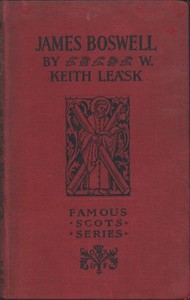
James Boswell — Background and Themes
2082
1
Project Gutenberg
2009
Boswell, James, 1740-1795; Authors, Scottish -- 18th century -- Biography; Biographers -- Great Britain -- Biography
Readers of public-domain and historical texts
Project Gutenberg digital edition
en
Edition facts
Words: 50,991
Reading time: 222 min
Text sections: 6
Source:
Project Gutenberg record #29615
W. Keith Leask's 1896 biography examines James Boswell's life and character through a Johnsonian lens, drawing on unpublished letters and a boyish commonplace book. The work contrasts Boswell's social ambition with his literary achievement, and includes vivid period details such as Edinburgh's 'gardy loo' and Lord Auchinleck's scornful dismissal of Johnson as 'a dominie.'
Editorial Edition Score
4.7/5
★★★★★
★★★★★
Calculated from edition completeness, EPUB availability, text structure and catalogue metadata. Not a user rating.
Edition quality
Leask opens his biography by positioning Boswell within the 'prodigious dimensions' of Johnsonian literature, acknowledging the risk of entering a 'well-ploughed field' already worked by Malone, Croker, Macaulay, and Carlyle. He stakes his claim on new material: unpublished letters and Boswell's boyish commonplace book, lent by J. Pearson & Co. The dedication to George Birkbeck Hill, 'Chief of Johnson Scholars,' signals the book's scholarly allegiance. Leask aims to correct the 'totally misleading essay by Lord Macaulay' and to lead general readers toward a 'correct understanding' of Boswell's Life of Johnson.
A Biography of Corrections
Leask's preface frames the book as a corrective to Macaulay's portrait of Boswell. He writes that he hopes to 'materially add to the correct understanding and the enjoyment of Boswell's great work.' The biography is thus not a neutral chronicle but an argument: that Boswell deserves reconsideration. Leask draws on unpublished letters and a 'boyish common-place book' to offer evidence beyond the familiar anecdotes. The dedication to Dr. Hill, who 'revised the proof sheets,' underscores the scholarly apparatus behind this revisionist project. Readers should note that Leask is writing in 1896, when Boswell's reputation was still recovering from Macaulay's damning caricature.
Edinburgh's Nocturnal Realities
Leask reconstructs Johnson's 1773 visit to Edinburgh with sensory precision. At ten o'clock, the 'beat of the city drums' sounded, and 'gardy loo' cries preceded the emptying of chamber pots onto the street. Leask quotes Boswell's wish that Johnson had been 'less gifted with the sense of smell.' The scene is drawn from Captain Burt's earlier account of a 'caddie' scouting ahead with cries of 'haud your han'.' Leask also notes that Boswell's house in James's Court had been occupied by David Hume three years earlier—a fact Boswell was 'reticent about,' given his disapproval of Hume's irreligion. The biography thus embeds Johnson's visit in a layered urban history, contrasting the philosopher's former study with the 'little infantine noise' of Boswell's daughter Veronica.
Lord Auchinleck's Dismissive Voice
Leask preserves the elder Boswell's contemptuous verdict on Johnson: 'a dominie, an auld dominie; he keepit a schule and ca'ad it an acaadamy.' The taunt, delivered in Scots dialect, targets Johnson's failed school at Edial near Lichfield. Leask glosses that 'no more bitter taunt could have been levelled against Johnson,' and connects it to the heritors' provision for Ruddiman and Michael Bruce. The passage reveals a family tension that Leask uses to dramatize Boswell's choice of mentor. Lord Auchinleck had already despaired of his son's attachment to Paoli; now Johnson was 'the land-louping scoundrel of a Corsican's' tail. The biography thus uses direct quotation to expose the social and intellectual rifts that shaped Boswell's career.
Leask's biography is best read alongside the Life of Johnson and Boswell's Journal of a Tour to the Hebrides. The author assumes familiarity with those works and with Macaulay's essay. Pay attention to the footnotes and the unpublished letters Leask cites; they are the book's original contribution. The preface's dedication to Dr. Hill also hints at the ongoing scholarly conversation about Boswell's reliability as a biographer.
Reader reflection
What was your reading experience?
Capture what you thought, learned, and would like to remember.
Your progress
0
/
10
2
How did the book work for you overall?
3
How likely are you to recommend this book?
4
Did the language feel accessible?
5
Was the book easy to understand?
6
Did the book meet your expectations?
7
Is this a title worth rereading?
8
Which aspect of the book did you value most?
9
What did this book teach you most?
10