1

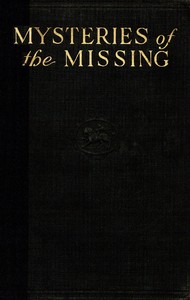
Mysteries of the missing — A Reader’s Guide
413
1
Project Gutenberg
2024
Biography; Kidnapping; Missing persons
Readers of public-domain and historical texts
Project Gutenberg digital edition
en
Edition facts
Words: 91,456
Reading time: 398 min
Text sections: 25
Source:
Project Gutenberg record #73706
Edward H. Smith's 1927 collection examines historical disappearances through a forensic and psychological lens, blending journalistic detail with literary allusion. The opening note invokes Homer's Lotus Eaters to frame a study of 'the unreturning adventurer.'
Editorial Edition Score
4.9/5
★★★★★
★★★★★
Calculated from edition completeness, EPUB availability, text structure and catalogue metadata. Not a user rating.
Edition quality
Edward H. Smith opens Mysteries of the Missing with an epigraph from Laus Veneris and a prefatory note that reaches back to Homer's Lotus Eaters, establishing a literary framework for the seventeen cases that follow. The book, published in 1927, treats disappearances ranging from the 1874 Charlie Ross kidnapping to the 1918 loss of the USS Cyclops. Smith, who also wrote Famous Poison Mysteries, approaches each case with a reporter's eye for detail and a psychologist's interest in motive. His narrative voice is measured yet evocative, often shifting between clinical summary and dramatic reconstruction. The excerpts show a writer attentive to chronology, police procedure, and the emotional toll on families, but also given to philosophical asides about 'the chemistry of wandering souls.'
A Voice Between Reportage and Reflection
Smith's prose oscillates between two registers. In the Whitla kidnapping account, he writes with the brisk efficiency of a newspaper dispatch: 'Before nightfall a hundred thousand officers were on the lookout in a thousand cities and towns through the eastern United States.' The specificity of numbers and geography grounds the narrative in verifiable fact. Yet the same chapter pauses to note that the parents 'acted with sense and caution' and were 'rich to the point of embarrassment'—a wry, almost novelistic observation. This dual voice appears throughout the excerpts: Smith can shift from a step-by-step reconstruction of a ransom drop to a broader reflection on human nature, as when he describes the kidnappers' instructions as coming 'very promptly through the mails.' The effect is a text that feels both authoritative and literary, never fully surrendering to either pure documentation or pure storytelling.
Pacing Through Procedural Detail
The narrative pace in the Whitla section is driven by a meticulous accumulation of temporal markers. Smith notes the time of the abduction, the discovery of the rented buggy at five o'clock, the arrival of the ransom note on the morning of the twentieth, and the father's departure for Cleveland at eight o'clock at night. This granular timeline creates a sense of urgency, as if the reader is watching events unfold in real time. Yet Smith also slows the pace to insert contextual information—the families' wealth, their decision to hire private detectives, the police's interference. The climax at Flatiron Park is rendered with deliberate restraint: 'The hours went wearily by, while the father's nervousness mounted.' The anticlimax—police watching the park all night, no one appearing—is delivered flatly, the pacing mirroring the father's deflation. Smith's control of tempo, alternating between rapid-fire updates and reflective pauses, is a consistent feature of his method.
Recurring Motifs: The Unseen and the Unknowable
Several motifs recur across the excerpts, suggesting Smith's thematic preoccupations. The idea of disappearance as a kind of enchantment appears in the prefatory note, which invokes lotus, Sirens, and Circe. This mythological framing returns implicitly in the Whitla case, where the kidnappers operate from the shadows, issuing commands through letters and leaving the father to wait in a hotel for 'the all-desired apparition of his little son.' The word 'apparition' hints at the ghostly quality of the missing—present only in memory and hope. Another motif is the failure of official systems: police interference 'ruined the plan' in the Whitla case, and the parents deliberately withhold information from authorities. Smith's interest lies not just in the facts of each case but in the psychological and structural forces that keep the missing absent. The excerpts never resolve the mysteries; they dwell instead in the space between evidence and uncertainty.
Readers approaching Mysteries of the Missing should attend to Smith's framing devices—the epigraph, the prefatory note, the chapter titles—which signal his ambition to elevate true crime into a meditation on absence. The book rewards those who read slowly enough to catch the shifts in tone and the recurring images of waiting, watching, and failed intervention. Smith's voice, at once detached and engaged, invites us to consider not only what happened to the missing but what their disappearances reveal about the limits of knowledge and the persistence of hope.
Reader reflection
Take a moment to reflect on this book
Create a short personal record of your experience with this book.
Your progress
0
/
10
2
What was your overall reaction to the book?
3
How likely are you to recommend this book?
4
What was the reading difficulty like?
5
How clear did the writing feel?
6
How would you rate its originality?
7
Could you apply anything you learned?
8
Did any part of the book feel personally relevant?
9
What did this book teach you most?
10