1

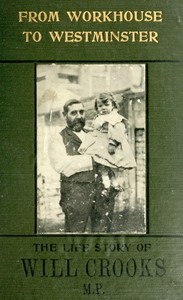
From Workhouse to Westminster: The Life Story of Will Crooks, M.P. — Key Ideas to Explore
16
1
Project Gutenberg
2012
Legislators -- Great Britain -- Biography; Crooks, William, 1852-1921; Social reformers -- Great Britain -- Biography
Readers of public-domain and historical texts
Project Gutenberg digital edition
en
Edition facts
Words: 80,071
Reading time: 349 min
Text sections: 9
Source:
Project Gutenberg record #41023
George Haw's biography of Will Crooks, a Labour MP who remained in the working class, uses Crooks's own words to recount his rise from poverty. The excerpts show a focus on municipal politics, slum property, and the tension between principle and public perception.
Editorial Edition Score
4.8/5
★★★★★
★★★★★
Calculated from edition completeness, EPUB availability, text structure and catalogue metadata. Not a user rating.
Edition quality
George Haw's biography of Will Crooks opens with a distinctive claim: it is 'the first biography of a working man who has deliberately chosen to remain in the ranks of working men as well as in their service.' This framing sets the tone for a narrative that prizes loyalty to class over personal advancement. Haw emphasizes that Crooks refused partnerships and salaries, preferring poverty and slander to abandoning his principles. The author also notes that he has tried to make Crooks 'the narrator as often as I could,' drawing on personal conversations. This method gives the biography an intimate, conversational quality, as if Crooks himself is speaking through Haw's prose.
A Biography Built from Conversation
Haw explains that he wanted Crooks to write an autobiography, but Crooks objected, believing men should not 'sit down to write about themselves.' Instead, Haw pieced together incidents from 'personal talks we have had together during our years of friendship.' The result is a hybrid: a biography that frequently shifts into first-person narration, with Crooks recounting events 'in his own words.' This technique gives the reader direct access to Crooks's voice—his idioms, his humor, his indignation. For instance, when a lady complains that Crooks's mayoralty reduced her husband's property profits from fifteen to ten percent, Crooks responds with a detailed, anecdotal critique of slum landlords and their agents. The reader hears Crooks's reasoning, not just Haw's summary.
The Mayor Who Refused a Salary
A central episode in the excerpts concerns Crooks's mayoralty of Poplar. Haw recounts that Crooks refused a salary, a decision that 'strengthened his position' despite initial misreporting by the Times. Crooks is quoted saying, 'I have only had to do what I have done in every other position I have held—let people understand that I have nothing to give away.' This refusal becomes a touchstone for his integrity. Yet Haw also shows the backlash: a church sewing-party lady declares it 'a shame' to make such people important, because her husband's rental income dropped. Crooks's rejoinder—that slum property pays well only because owners neglect repairs and leave rent collection to 'flint-hearted agents'—reveals his sharp class analysis.
Slum Property and the Human Cost
Crooks's critique of slum landlords is vivid and specific. He describes an agent who 'waits and watches round the corner on Sunday morning' to seize a wife's few pence for Sunday dinner. He tells of a wealthy owner who, when told a widow would need parish relief if her rent were doubled, replied, 'I leave these matters to my agent. I don't want the woman's money,' while pulling sovereigns from his pocket. These anecdotes are not abstract; they are drawn from Crooks's experience as a Labour representative and mayor. Haw presents them as evidence of the systemic exploitation that Crooks fought. The excerpts do not reveal whether Crooks succeeded in reforming Poplar's housing, but they establish his rhetorical strategy: personal stories that indict an entire system.
The Limits of the Excerpts: What We Don't Know
The excerpts cover only the preface and a portion of the mayoralty chapter. They do not show Crooks's childhood in the workhouse (despite the title), his entry into politics, or his career as an MP. The reader learns that Crooks was a Labour mayor of Poplar, that he refused a salary, and that he was a sharp critic of slum landlords. But the narrative arc—how he moved 'from workhouse to Westminster'—is missing. Haw's preface promises a story of a man who 'has not risen from the ranks' but remains 'four-square with the working classes.' The excerpts confirm that stance, but the full book likely traces his journey from poverty to Parliament, with many more such anecdotes. The reader should expect a partisan but intimate portrait, built on friendship and shared conviction.
Readers approaching this biography should listen for Crooks's voice. Haw has woven his subject's own words throughout, making the book as much an oral history as a conventional life story. The excerpts suggest a work that is episodic, anecdotal, and argumentative—less a chronological narrative than a series of set-pieces illustrating Crooks's character and principles. For those interested in early Labour politics, municipal reform, or the lived experience of class in Edwardian London, this book offers a rare insider's perspective, filtered through a sympathetic but not uncritical biographer.
Reader reflection
Record your reading impressions
A brief reflection can help important ideas stay with you longer.
Your progress
0
/
10
2
Was reading this book enjoyable?
3
Would you recommend this book to another reader?
4
How easy was the book to follow?
5
Do you expect to return to this book?
6
What did you think about the pace?
7
Would you like to discuss this book with someone?
8
What did you appreciate most?
9
What did this book teach you most?
10