1

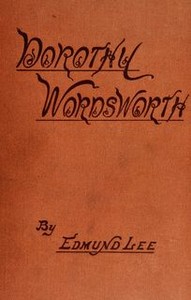
Dorothy Wordsworth: The Story of a Sister's Love — Background and Themes
465
2
Project Gutenberg
2012
Authors, English -- 19th century -- Biography; Wordsworth, Dorothy, 1771-1855; Wordsworth, William, 1770-1850 -- Family; Sisters -- Great Britain -- Biography
Readers of public-domain and historical texts
Project Gutenberg digital edition
en
Edition facts
Words: 56,386
Reading time: 246 min
Text sections: 7
Source:
Project Gutenberg record #41506
Edmund Lee's 1886 memoir compiles scattered references into a portrait of Dorothy Wordsworth, focusing on her role in the Lake District literary circle. The excerpts reveal Lee's reliance on letters and recollections, emphasizing Dorothy's influence on Wordsworth and Coleridge, her domestic life at Grasmere, and the family's grief after Captain John Wordsworth's death.
Editorial Edition Score
4.7/5
★★★★★
★★★★★
Calculated from edition completeness, EPUB availability, text structure and catalogue metadata. Not a user rating.
Edition quality
Edmund Lee opens his 1886 memoir with a frank admission: no biography of Dorothy Wordsworth existed before his, aside from a sketch by Professor Shairp. He positions himself as a compiler, gathering allusions from biographies of her brother and reviews of his works. The preface dedicates the book to Miss Quillinan, a link between past and present generations of the Wordsworth family. Lee's stated aim is to produce a memoir that gives Dorothy a place in female biography, a gap he finds surprising given her influence on the revival of English poetry. The work draws heavily on published letters and reminiscences, including those of Henry Crabb Robinson and F. W. H. Myers.
A Compiler's Method and Sources
Lee describes his task as that of a compiler rather than an author, acknowledging debts to multiple authorities. He credits Dr. Sadler for permission to reprint Dorothy's letters to Henry Crabb Robinson, and Mr. F. W. H. Myers for letters that first appeared in his Wordsworth. The preface also notes that the book originated from surprise that no memoir existed, despite frequent references to Dorothy in other works. This framing suggests readers will encounter a work built from fragments, not a continuous narrative. Lee's approach is evident in the chapters: he weaves together letters, diary entries, and third-person accounts, often letting Dorothy's own words and those of her circle carry the story.
Grasmere as a Domestic and Literary Hub
The excerpts show Grasmere as a place of intense domestic care and literary exchange. Coleridge's letter to Thomas Wedgewood, quoted by Lee, describes how Wordsworth's wife and sister sat up with him during a month-long illness, waking him at the first signs of distress and weeping for him even in their dreams. This passage underscores Dorothy's role as a nurse and emotional support. The chapter on life at Grasmere also details Captain John Wordsworth's prolonged visits, during which fraternal ties were renewed. Lee notes that Captain Wordsworth, a sailor, became known among his craft as 'The Philosopher' and was described by Coleridge as 'one of you—a man who hath solitary usings of his own intellect.' The household's mutual devotion is a recurring theme.
The Sorrow of Captain John Wordsworth's Death
Lee records the death of Captain John Wordsworth in early 1805 as a great sorrow for Dorothy and the family. The captain, a younger brother of the poet, had spent eight months at Grasmere, strengthening bonds with his siblings. He had hoped to settle there after a few prosperous voyages, adding his worldly store to enable Wordsworth to write without financial worry. Lee quotes Coleridge's praise of the captain's 'subtle tact, and swift instinct of true beauty,' and notes that Wordsworth called him 'a silent poet.' The loss is presented as a turning point, though the excerpts do not reveal its full aftermath. Lee's reliance on letters and recollections gives this section a poignant, documentary quality.
Dorothy's Voice Through Letters and Recollections
Lee's method of compiling letters and reminiscences allows Dorothy's own voice to emerge, albeit filtered. The excerpts include a letter from Coleridge describing her care, and references to her correspondence with Crabb Robinson. Lee does not invent dialogue or interiority; instead, he presents Dorothy through the observations of others and her own written words. This approach aligns with his stated goal of gathering 'allusions' into a memoir. Readers should note that the book is not a critical biography but a Victorian-era compilation, shaped by Lee's reverence for his subject. The text preserves variant spellings and inconsistencies, as the transcriber notes, adding a layer of historical texture.
Lee's memoir offers a starting point for understanding Dorothy Wordsworth's life within the Lake District circle. Readers should approach it as a compilation of contemporary sources rather than a modern analytical biography. The excerpts highlight domestic intimacy, literary influence, and personal loss, but the full work likely expands on these themes across seven chapters. For those seeking Dorothy's own perspective, the letters quoted provide direct access to her voice, while Lee's framing reflects late-Victorian attitudes toward female biography.
Reader reflection
Take a moment to reflect on this book
Create a short personal record of your experience with this book.
Your progress
0
/
10
2
Was reading this book enjoyable?
3
How likely are you to recommend this book?
4
How demanding did the text feel?
5
Was the book moving at the right speed?
6
Would this book work well in a reading group?
7
How distinctive were its ideas or approach?
8
Was the book easy to understand?
9
What did this book teach you most?
10