1

Some Noble Sisters — Background and Themes
28
3
Project Gutenberg
2014
Women -- Biography; Sisters -- Biography
Readers of public-domain and historical texts
Project Gutenberg digital edition
en
Edition facts
Words: 67,059
Reading time: 292 min
Text sections: 8
Source:
Project Gutenberg record #46698
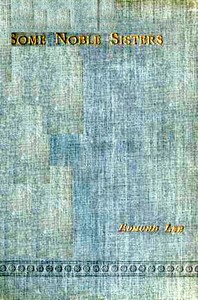
Edmund Lee's 1892 collection profiles eight notable sisters—including Dorothy Wordsworth, Mary Lamb, and Caroline Herschel—through biographical sketches that emphasize influence and devotion. The preface frames the work as a suggestive, not exhaustive, record aimed at young women.
Editorial Edition Score
4.7/5
★★★★★
★★★★★
Calculated from edition completeness, EPUB availability, text structure and catalogue metadata. Not a user rating.
Edition quality
Edmund Lee's Some Noble Sisters (1892) opens with a preface that explicitly frames the work as a 'slight' and 'fragmentary' collection, intended to be 'suggestive' rather than exhaustive. The editor's stated audience is young women, and the tone is consistently instructive and consolatory. The eight biographical sketches—ranging from Mary Sidney to Eugénie de Guérin—are united by a focus on sisterly devotion and moral influence, a theme Lee introduces as a neglected 'province of influence' peculiarly belonging to women.
The narrative voice is reverent and often sentimental, leaning on quoted testimony from contemporaries. In the Dorothy Wordsworth chapter, for instance, Lee reproduces Lady Richardson's observation that Wordsworth's 'tones of voice become very gentle and soothing' when speaking of his sister. The prose moves between summary and anecdote, with occasional shifts into direct quotation that lend immediacy to the portraits.
A Compilation of Devotion and Influence
Lee's preface establishes the book's governing idea: that 'influence' is a moral force and women's special domain. He does not claim originality, noting that 'the absence of such a record hitherto can alone justify the appearance of this fragmentary and imperfect work.' The structure is a series of independent lives, each drawn from published sources—memoirs, journals, letters—which Lee synthesizes into short narratives. The chapter on Mary Lamb, for example, relies on Charles Lamb's writings and biographical accounts to trace her childhood, her family's 'hereditary taint of insanity,' and her later collaboration with her brother. Lee's method is to assemble rather than analyze; he offers little critical commentary, preferring to let quoted material carry the emotional weight. The result is a book that feels more like a curated anthology than a unified argument.
Voice and Pacing: From Sentiment to Sudden Grief
The prose in Some Noble Sisters moves at a measured, often sentimental pace, but it can shift abruptly into moments of stark pathos. In the Dorothy Wordsworth section, Lee describes her final years with a quiet dignity: 'She is drawn about as usual in her chair.' Then, without warning, he reports her reaction to Wordsworth's death: 'life had nothing left worth living for.' The contrast between the placid image of the chair and the raw exclamation creates a jolt. Similarly, in the Mary Lamb chapter, the narrative lingers on her lonely childhood—'a lonely childh[ood]'—before recounting the family tragedy with a sudden, almost clinical directness. These shifts in pace are not always smooth; they reflect Lee's reliance on source material that he stitches together, sometimes leaving seams visible. The effect is a reading experience that oscillates between gentle reflection and abrupt confrontation with suffering.
Recurring Details: The Weight of Domestic Space
Lee repeatedly anchors his sketches in specific domestic settings. The Lambs' home in Crown Office Row, the Wordsworths' Dove Cottage, and the Herschel family's residence all appear as more than backdrops; they are charged with emotional history. Dove Cottage, Lee notes, 'was for some years among the most treasured possessions of the present writer,' who conveyed it as a Wordsworth Memorial. This personal stake in the physical space gives the Dorothy Wordsworth chapter an unusual intimacy. In the Mary Lamb sketch, the 'uncongenial home' and the 'solitude of her own thoughts' are presented as formative pressures. These domestic details are not merely decorative; they function as evidence of the sisters' constrained spheres and the quiet heroism Lee wishes to celebrate. The recurring emphasis on home and hearth reinforces the book's central claim that influence operates most powerfully in private life.
Lee's collection is best approached as a period piece—a Victorian moral anthology that values edification over analysis. Readers interested in the construction of female biography in the 1890s will find revealing patterns in Lee's selection of sources and his editorial voice. The book's value lies less in its biographical accuracy than in its reflection of a cultural moment that saw sisterly devotion as a model for women's influence. For those tracing the reception of figures like Dorothy Wordsworth or Mary Lamb, Lee's sketches offer a contemporary, if idealized, portrait.
Reader reflection
What was your reading experience?
Capture what you thought, learned, and would like to remember.
Your progress
0
/
10
2
Did this book hold your interest?
3
How likely are you to recommend this book?
4
What was the reading difficulty like?
5
How understandable was the text?
6
Was the book what you thought it would be?
7
Would you like to discuss this book with someone?
8
Would a second reading be valuable?
9
What is the main idea you are taking away?
10